


Construction's Labor Problem Isn't Going Away—So the Industry Is Adapting

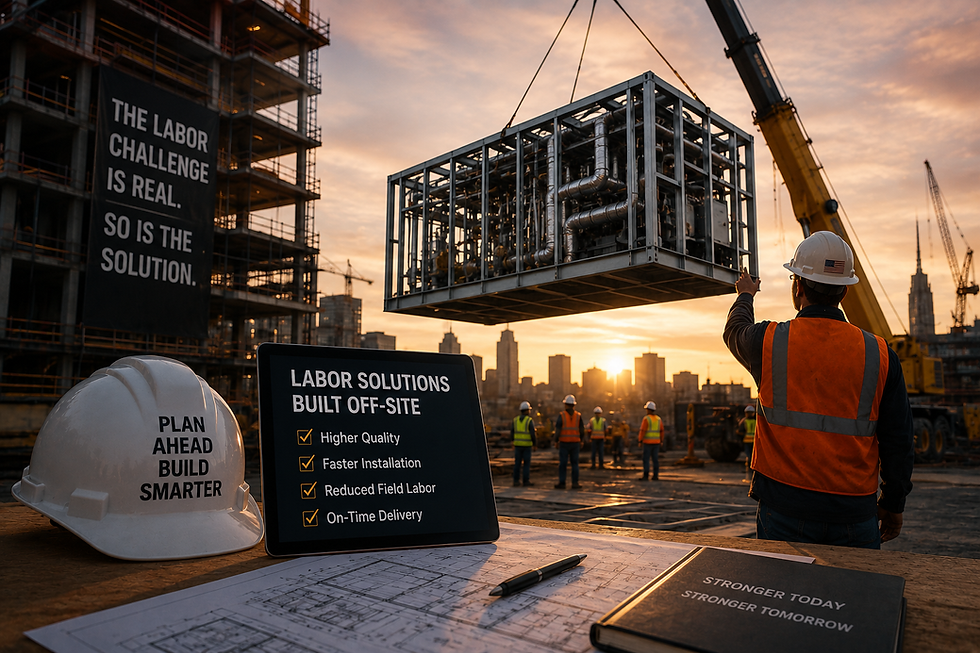
For years, construction has been talking about the labor shortage.
At this point, it's become the industry's version of discussing the weather.
Everyone knows it's happening.
Everyone is experiencing it.
And everyone is trying to figure out how to work around it.
The challenge is that this isn't a temporary problem anymore.
It's becoming a structural one.
As we move through 2026, Associated Builders and Contractors estimates the industry will need to add roughly 349,000 new workers just to keep pace with current nonresidential construction activity and the growing backlog of large-scale projects.
That's not a small number.
That's an entire workforce challenge.
And unfortunately, several trends are moving in the wrong direction at the same time.
The Labor Pool Was Already Tight
Even before recent immigration restrictions, construction was struggling to attract enough workers.
An aging workforce, retirements, declining participation in the skilled trades, and increasing competition from other industries had already placed significant pressure on labor availability.
Many contractors have been operating in a world where finding qualified workers is often harder than finding projects.
That's a remarkable shift.
Historically, companies worried about where the next job would come from.
Today, many are asking:
"Do we have enough people to build the jobs we've already won?"
That's a very different problem.
Immigration Restrictions Are Adding More Pressure
Regardless of where someone falls politically on immigration policy, one reality is difficult to ignore:
The construction industry has long relied on immigrant labor.
From skilled tradespeople to laborers, immigrant workers have played an important role in helping projects move from paper to reality.
As immigration pathways become more restrictive and labor mobility becomes more constrained, the available workforce naturally becomes smaller.
And when demand remains high while labor supply tightens, pressure builds throughout the system.
Developers feel it.
Contractors feel it.
Owners feel it.
Schedules feel it.
Everyone feels it.
The Cost Isn't Just Labor
Most people immediately think about wage inflation when labor shortages are discussed.
And that's certainly part of the equation.
But the larger issue is often predictability.
Labor shortages can create:
schedule delays
sequencing challenges
productivity losses
subcontractor availability issues
and increased project risk
A project can survive higher labor costs.
What becomes far more difficult to manage is uncertainty.
Construction already has enough variables.
Adding labor unpredictability into the mix only increases risk.
Developers Are Starting to Think Differently
One of the most interesting responses to this challenge is happening at the developer level.
The most forward-thinking developers aren't simply asking:
"How do we find more labor?"
They're asking:
"How do we need less labor in the field?"
That may sound like a subtle distinction.
It isn't.
Because it shifts the conversation from workforce availability to project strategy.
And increasingly, that strategy points toward prefabrication.
Off-Site Fabrication Is Having a Moment
For years, prefabrication has been discussed as one of construction's great opportunities.
Today, it is becoming less of an option and more of a necessity.
Projects exceeding $25 million are increasingly incorporating off-site fabrication into their planning strategies.
Why?
Because labor is often easier to manage in a controlled manufacturing environment than it is across multiple job sites.
Factories provide:
consistent workflows
improved quality control
predictable staffing
safer working conditions
and greater production efficiency
The result is fewer labor-intensive activities occurring in the field.
And that's becoming incredibly valuable.
MEP Skids Are Solving More Than One Problem
One area seeing significant growth is the use of pre-assembled MEP skids.
For those unfamiliar, MEP skids combine mechanical, electrical, and plumbing systems into factory-built assemblies that arrive on-site substantially complete.
Instead of assembling hundreds of components piece by piece in the field, contractors install larger integrated systems.
That creates several advantages:
reduced field labor requirements
shorter installation durations
improved quality
better coordination
and greater schedule certainty
Perhaps most importantly, they help developers and contractors maintain aggressive schedules despite workforce constraints.
In today's market, that's a competitive advantage.
This Is Really About Risk Management
The conversation around prefabrication is often framed as an efficiency discussion.
But I think that's only part of the story.
What developers are really buying is risk reduction.
Every labor shortage introduces uncertainty.
Every uncertainty introduces risk.
And every risk threatens schedule, budget, and project outcomes.
Early incorporation of prefabricated systems allows project teams to eliminate many of those variables before construction even begins.
That's incredibly powerful.
The Industry Is Being Forced to Innovate
Construction has never been famous for rapid change.
If we're being honest, the industry often treats change the way homeowners treat unexpected foundation repairs.
Necessary.
But not particularly exciting.
Yet labor realities are forcing innovation.
Developers, contractors, and suppliers are increasingly looking for ways to build smarter rather than simply harder.
And that's creating opportunities for:
prefabrication
modular construction
advanced manufacturing
early supplier engagement
and more collaborative project planning
Many of these ideas have existed for years.
What's changing is the urgency behind them.
The Bigger Lesson
The labor shortage isn't a future problem.
It's a current reality.
And while workforce development remains critically important, many project teams are recognizing that they can't simply hire their way out of the challenge.
Instead, they're redesigning how projects are delivered.
The winners in this environment may not be the teams with the largest workforce.
They may be the teams that require the least field labor to achieve the same result.
A Thought
Every major challenge eventually creates innovation.
Construction's labor shortage may ultimately accelerate changes the industry should have embraced years ago.
Closing Question
How is labor availability influencing the way your projects are being designed, procured, or delivered today?


