


Renewable Energy Has Moved Beyond Environmental Policy. It's Now an Economic Necessity.

For years, discussions around solar and wind energy tended to follow predictable lines.
One side talked about carbon emissions.
The other talked about costs.
The debate often centered on environmental priorities versus economic realities.
What's interesting today is that those two conversations are increasingly becoming the same conversation.
Because renewable energy is no longer being deployed simply because it's cleaner.
It's being deployed because it makes economic sense.
And increasingly, because we don't have much choice.
The Energy Conversation Has Changed
A decade ago, renewable energy was often viewed as an alternative.
Today, it is rapidly becoming the foundation of new power generation.
Developers are planning to bring a record amount of new generating capacity online across the United States, with solar, wind, and battery storage accounting for the overwhelming majority of new additions.
That's not happening because utilities suddenly became environmental activists.
It's happening because the economics have fundamentally shifted.
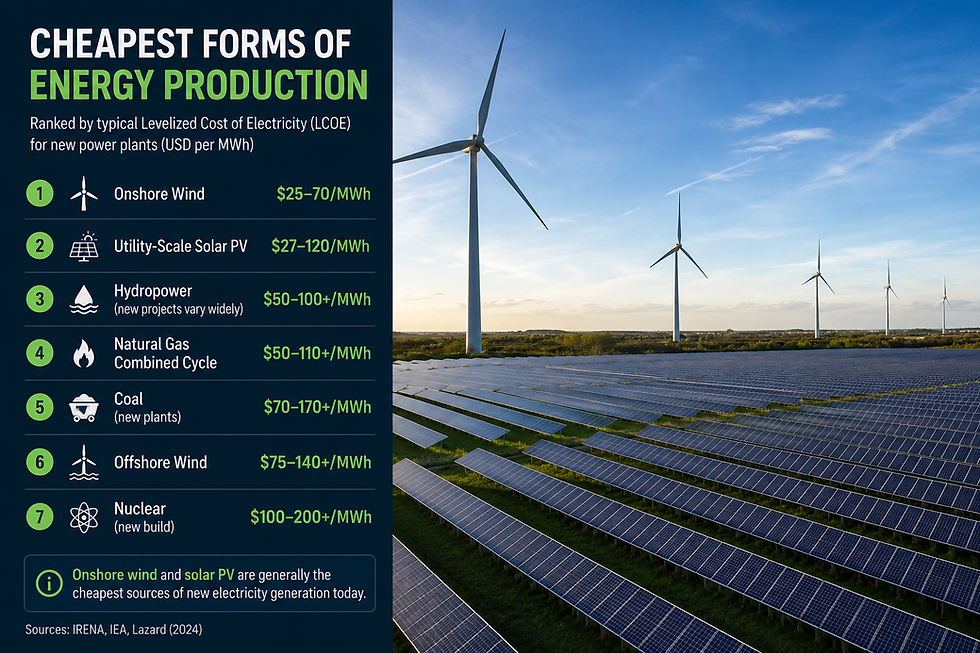
In many markets, utility-scale solar and wind are now among the lowest-cost sources of new electricity generation available.
When the cleanest option also happens to be one of the cheapest options, adoption tends to accelerate quickly.
And that's exactly what we're seeing.
Solar Has Become the Workhorse
If renewable energy had an MVP award right now, solar would win it by a landslide.
Deployment is accelerating at a pace that would have seemed almost unimaginable just a few years ago.
What's driving that growth?
Part of the answer is simple:
Speed.
Solar projects can often be developed and deployed faster than many traditional generation sources.
But the larger factor is demand.
And that demand is coming from places many people don't expect.
AI Is Creating a New Energy Challenge
The rise of artificial intelligence is creating enormous opportunities.
It's also creating enormous energy demand.
Every AI model.
Every cloud platform.
Every large-scale computing environment.
Every hyperscale data center.
They all require electricity.
A lot of it.
The modern economy increasingly runs on data.
And data runs on power.
The challenge is that data center development is growing faster than many regions can comfortably support with existing infrastructure.
Utilities aren't just trying to meet today's demand.
They're trying to anticipate tomorrow's.
That's becoming increasingly difficult.
Data Centers Are Reshaping More Than Construction
I've written previously about how data centers are becoming the black hole of construction resources, pulling steel, electrical equipment, labor, and fabrication capacity toward them.
But they are also becoming a major force in energy markets.
Large technology companies are making enormous investments in securing reliable electricity supplies.
Utilities are racing to expand generation capacity.
Grid operators are facing unprecedented forecasting challenges.
In many regions, renewable energy is emerging as one of the fastest and most economically viable ways to help meet that demand.
This isn't simply an environmental strategy.
It's an infrastructure strategy.
Wind Energy Is Quietly Making a Comeback
While solar often dominates headlines, wind energy is experiencing a significant resurgence as well.
Several large-scale projects are moving forward, including some of the largest onshore wind developments ever built in the United States.
What makes wind particularly valuable is that it complements solar.
Solar performs during the day.
Wind often generates strongest output during different periods.
Together, they create a more balanced energy portfolio.
And as deployment increases, economies of scale continue improving project economics.
Batteries Are Becoming the Missing Piece
Of course, every renewable energy conversation eventually arrives at the same question:
"What happens when the sun isn't shining and the wind isn't blowing?"
That's where battery storage enters the picture.
The growth of utility-scale battery systems may be one of the most important infrastructure stories happening today.
For years, critics argued that renewable energy could never become a major contributor because of intermittency challenges.
Battery technology is rapidly changing that equation.
As storage capacity grows, renewable energy becomes increasingly dispatchable, reliable, and valuable to grid operators.
The result is a cleaner grid that's also more flexible.
The Grid Is Becoming the New Bottleneck
Ironically, one of the biggest challenges facing renewable energy isn't generation.
It's connection.
Across the country, massive backlogs exist for projects waiting to connect to the electrical grid.
In some regions, developers face years-long delays before projects can receive approval to interconnect.
The irony is hard to miss.
The generation capacity exists.
The investment capital exists.
The demand certainly exists.
The challenge is building the infrastructure necessary to connect everything together.
In many ways, transmission has become the next great construction challenge.
This Is Ultimately an Economic Story
The most fascinating part of the renewable energy transition is that it is increasingly being driven by economics rather than ideology.
Businesses want affordable electricity.
Data centers need reliable electricity.
Manufacturers need predictable electricity.
Communities need resilient electricity.
Solar, wind, and battery storage are increasingly helping provide all four.
That's why deployment continues accelerating despite policy shifts, supply chain challenges, and market uncertainty.
The underlying economics remain compelling.
The Bigger Lesson
Renewable energy is often framed as a sustainability story.
And it certainly is one.
But it is also becoming a competitiveness story.
A grid capacity story.
An economic development story.
And increasingly, an AI infrastructure story.
As data centers continue multiplying and electricity demand grows, renewable energy will play a critical role in determining whether the United States can build enough power capacity to support the next generation of digital infrastructure.
The question is no longer whether we need more renewable energy.
The question is whether we can deploy it fast enough.
A Thought
The future may not be powered by solar and wind simply because they're cleaner.
It may be powered by solar and wind because they're the fastest and most economical way to keep up with the world's growing appetite for electricity.
Closing Question
How do you see growing power demand from AI and data centers influencing the future of energy infrastructure and construction?


